
Non-active implantable medical devices are implantable medical devices that function without an external power source and rely on structural support, material properties, or biocompatibility to repair, replace, or support human tissues and organs.
In recent years, products such as absorbable vascular scaffolds, neurovascular embolization devices, 3D-printed joint prostheses, and biodegradable bone repair materials have attracted strong attention in the global market.
Driven by population aging, rising chronic disease prevalence, and ongoing progress in biomaterials and precision manufacturing, the market for non-active implantable medical devices continues to expand. This article reviews 7 high-growth segments and examines where future opportunities may emerge for manufacturers, suppliers, and investors.

The Non-Active Implantable Device Market Continues to Expand in 2026
By 2026, the global implantable medical devices market is projected to exceed USD 109.47 billion[1]. According to multiple industry research institutions, the non-active implantable medical devices market is expected to maintain steady growth over the next decade, with non-active implantable medical devices remaining a core growth segment[1,2,3].
China remains one of the fastest-growing regions due to its aging population, expanding healthcare access, and domestic manufacturing capacity. According to China’s National Medical Products Administration, non-active implants ranked among the leading Class III medical device registrations in 2025, with registrations increasing by 5.1% year over year[4].
Several core drivers are supporting market expansion:
| • Rising prevalence of cardiovascular disease, osteoporosis, arthritis, and neurological disorders • Increasing demand for minimally invasive treatment • Wider clinical use of biodegradable and bioactive materials Growth of personalized and 3D-printed implant solutions • Continued investment in local manufacturing and supply chain localization |
Innovation demand is also reshaping industry collaboration. Device manufacturers increasingly need support from material suppliers, precision machining companies, polymer developers, sterilization providers, and regulatory experts. This has made international industry platforms more important for partnership building and product commercialization.
As one of Asia’s major medical devices exhibitions, Medtec China has become an important on-site opportunity for companies involved in non-active implantable medical devices, especially in cardiovascular intervention, neurointervention, biomaterials, and minimally invasive technologies. Free tickets are available until 30 August.
Learn more about 2026 Medtec China:
Medtec China: Uniting Medical Device R&D and Global Manufacturing
Free Tickets Open for 2026 Medtec
7 High-Growth Categories in Non-Active Implantable Medical Devices
| # | Segment | Representative Product Categories | Example Products | Market Characteristics | Leading Global Companies |
| 1 | Neurosurgical implants | Aneurysm clips, dural substitutes, nerve repair materials | Yasargil Clip; DuraGen; Axoguard Nerve Protector | High precision requirements; rising demand for minimally invasive delivery; growing use in complex neurological repair | Medtronic; B. Braun; Integra LifeSciences |
| 2 | Cardiovascular implants | Prosthetic heart valves, vascular grafts, stent-grafts | SAPIEN 3; Evolut PRO+; GORE TAG; Valiant | Highest technical barriers; strong evidence requirements; continued innovation in transcatheter and bioresorbable technologies | Edwards Lifesciences; Medtronic; W. L. Gore & Associates |
| 3 | Sports injury repair implants | Anchors, interference screws, plates, PEEK fixation systems | SwiveLock; BioComposite Interference Screw; PEEK Knotless Anchor | Rising sports medicine demand; arthroscopic repair and early functional recovery are key priorities | Arthrex; Zimmer Biomet; DePuy Synthes |
| 4 | Orthopedic bone filler and repair materials | Bone substitutes, bone void fillers, graft substitutes | Vitoss; ChronOS; PRO-DENSE | Differentiation comes from bioactivity, handling, and resorption profile | Stryker; DePuy Synthes; Zimmer Biomet |
| 5 | Joint replacement implants | Hip prostheses, knee systems | Persona; Exeter V40; Trident II | Large installed base; premium segment values long-term clinical data and patient-specific fit | Zimmer Biomet; Stryker; Smith+Nephew |
| 6 | Plastic surgery implants | Breast implants, PDO threads, soft tissue implant materials | Natrelle; Mentor MemoryGel; PDO threads | Strong consumer demand; focus on safety, natural results, and absorbable materials | AbbVie (Allergan Aesthetics); Mentor, a Johnson & Johnson company |
| 7 | Tissue engineering scaffold materials | Dermal templates, cartilage scaffolds, acellular matrices | Integra Dermal Regeneration Template; MACI; AlloDerm | Frontier segment with high R&D intensity; 3D bioprinting and regenerative applications are expanding | Integra LifeSciences; Vericel; Organogenesis |
Note: This table is for reference only. The product examples and company names listed here are intended to illustrate representative market segments and may vary by region or source.
You may also be interested in: Top 10 Surgical Robot Companies in 2026
Cardiovascular and Neurointerventional Segments Draw Strong Attention
Among all non-active implantable medical devices, cardiovascular and neurovascular implants remain among the most active innovation areas.
In cardiovascular intervention, coronary stents, peripheral vascular stents, and transcatheter valve products continue to evolve toward thinner structures, improved biocompatibility, and absorbable materials. Domestic Chinese manufacturers have also significantly increased market penetration, especially after centralized procurement policies accelerated local adoption.
In neurointervention, demand for aneurysm embolization, intracranial support devices, and neural repair materials continues to rise alongside the expansion of stroke treatment. Precision manufacturing and biomaterial compatibility remain critical technical barriers in this segment.
Competitive Landscape and Key Challenges
The global market remains dominated by multinational companies such as Medtronic, Johnson & Johnson, Boston Scientific, and Zimmer Biomet, particularly in high-end implant systems and core biomaterials.
At the same time, Chinese orthopedic implant manufacturers and cardiovascular device companies are narrowing the gap through localized manufacturing, price competitiveness, and clinical adaptation.
However, several challenges remain across the non-active implantable medical devices industry:
• High-end materials such as specialty ceramics and medical polymers still rely partly on imports
• Clinical validation cycles for Class III implantable medical devices remain long
• International compliance requirements continue to tighten under standards such as ISO 14630
• Precision manufacturing and long-term biocompatibility testing require substantial investment
4 Major Future Trends of Non-Active Implantable Medical Devices
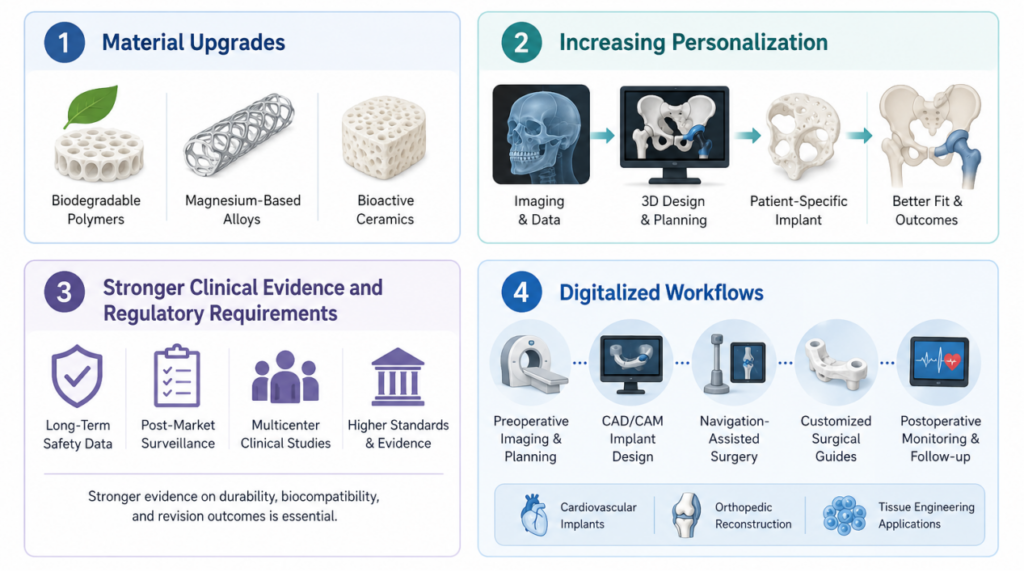
1. Material Upgrades
Biodegradable polymers, magnesium-based alloys, and bioactive ceramics are increasingly used in non-active implants and non-active surgical implants.
Absorbable vascular scaffolds and biodegradable orthopedic materials are attracting increasing research attention because they reduce long-term foreign-body retention after healing.
2. Increasing Personalization
Patient-specific implants are expanding rapidly through 3D printing and digital imaging integration.
Customized joint prostheses, spinal implants, and tissue scaffolds improve anatomical fit and surgical planning accuracy. Personalized passive implant design is expected to grow further in reconstructive and orthopedic applications.
3. Stronger Clinical Evidence and Regulatory Requirements
Regulators worldwide are placing more emphasis on long-term safety data, post-market surveillance, and multicenter clinical studies for implantable medical devices.
Manufacturers of non-active implantable medical devices increasingly need stronger evidence regarding durability, biocompatibility, and revision outcomes before commercialization.
4. Digitalized Workflows
Digital technologies are reshaping the entire implant process, including:
• Preoperative imaging and surgical planning
• CAD/CAM-based implant design
• Navigation-assisted surgery
• Customized surgical guides
• Postoperative monitoring and follow-up systems
Digital workflows are particularly important for cardiovascular implants, orthopedic reconstruction, and tissue engineering applications.
About Medtec China
As competition intensifies in non-active implantable medical devices, industry collaboration is becoming increasingly important for commercialization, regulatory readiness, and material innovation.
For companies involved in non-active implantable medical devices, Medtec China provides access to one of Asia’s most active medical manufacturing ecosystems. The event attracts global suppliers, OEM manufacturers, R&D teams, investors, and procurement professionals seeking collaboration opportunities across the medical device supply chain.
More information, visitor ticket, and exhibition updates are available through the official website:
References:
[1] Implantable Medical Devices Market Drivers and New Developments. Available at: https://www.towardshealthcare.com/insights/implantable-medical-devices-market-sizing (Accessed: 29 May 2026)
[2] Implantable Medical Devices Market (2024 – 2030). Available at: https://www.grandviewresearch.com/industry-analysis/implantable-medical-devices-market-report (Accessed: 29 May 2026)
[3] 植入式医疗器械市场 大小和分享 2025 – 2034. Available at: https://www.gminsights.com/zh/industry-analysis/implantable-medical-devices-market (Accessed: 29 May 2026)
[4] 2025年度医疗器械注册工作报告. Available at: https://www.nmpa.gov.cn/xxgk/fgwj/gzwj/gzwjylqx/20260224172356196.html (Accessed: 29 May 2026)