
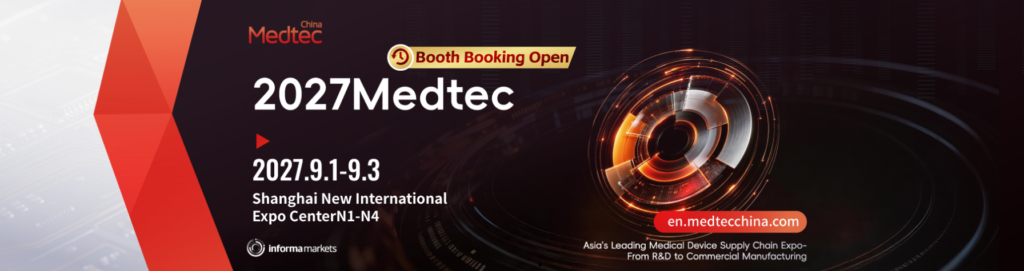
Sustained breakthroughs across polymer chemistry, additive fabrication, and laser micromachining continue redefining how modern therapeutic hardware is developed. Attending a dedicated medical manufacturing trade show offers cross-functional research specialists direct exposure to high-purity medical plastics, precision machining setups, and surface functionalization technologies. Operating as Medtec China, our team organizes a premier global platform focused on healthcare equipment design and manufacturing supply chains, hosting its upcoming session from September 1 to 3, 2027, across Halls N1 to N4 at the Shanghai New International Expo Center.
Delegates exploring the venue gain immediate access to specialized exhibits covering super-precision laser processing, CNC machine tools, molding services, and extrusion technologies housed within the International Pavilion across Halls N1 and N2. Global visitors are encouraged to register through our official portal today to plan their journey to Shanghai and review detailed delegation options.
Polymer Engineering in Advanced Catheter and Fluid Management Systems
Selecting base resin formulations for vascular catheters or IV fluid pathways involves balancing chemical resistance against mechanical flexibility. Advanced polyether block amides, fluoropolymers, and medical-grade polyurethanes enable component processors to extrude thin-walled multi-lumen tubing with precise dimensional control. Polymer chemists analyze melt flow dynamics under high shear rates to prevent wall thickness variations and internal lumen collapsing.
Surface modification strategies optimize fluid dynamics while minimizing insertion friction along vascular delivery channels. Applying hydrophilic coatings through plasma surface treatment or UV cross-linking significantly reduces drag forces during clinical procedures. Maintaining controlled chemical bonding prevents coating detachment or particulate generation in sensitive physiological environments.
Processing melt temperatures must remain strictly regulated to avoid thermal degradation in heat-sensitive resins. Automated extrusion systems utilize multi-axis laser micrometers to evaluate outer diameters and wall uniformity continuously during high-speed production runs. Implementing real-time dimensional monitoring lowers scrap rates and stabilizes quality across high-volume production batches.
Laser Micromachining and Additive Metal Processing Innovations
Micro-scale component fabrication demands localized energy delivery capable of shaping delicate substrates without inducing thermal distortion. Ultrafast femtosecond lasers cut intricate Nitinol stent meshes and sub-millimeter hypotubes without creating heat-affected zones or structural micro-cracks. Utilizing ultrashort light pulses achieves clean kerf edges, reducing the need for secondary chemical etching routines.
Additive manufacturing using bio-compatible titanium or cobalt-chromium powders enables the fabrication of customized orthopedic implants with porous lattice structures. Selective laser melting controls pore size distribution to match human trabecular bone density, encouraging osseointegration at bone-implant interfaces. Precise thermal management during powder bed fusion prevents residual stress accumulation across complex geometries.
At Medtec, international delegates can explore live demonstrations of super-precision laser processing systems, multi-axis CNC machine tools, and molding equipment displayed across Halls N1 and N2 in the International Pavilion. High-precision laser cutters demonstrate rapid stent slotting, while advanced extrusion lines showcase continuous micro-tubing fabrication in real time. Observing these working equipment setups helps process engineers calculate throughput metrics and plan cleanroom floor layouts effectively.
Surface Passivation and Cleanroom Quality Verification Metrics
Preserving corrosion resistance across metallic surgical tools and implantable hardware requires controlled chemical passivation protocols. Citric and nitric acid passivation baths selectively remove free iron contaminants from machined stainless steel or titanium surfaces, promoting the formation of a dense passive chromium oxide layer. Electrochemical impedance spectroscopy evaluates oxide film stability, verifying long-term resistance to bodily fluid corrosion.
Cleanroom environmental control systems regulate airborne particulate levels to maintain ISO Class 5 or Class 7 manufacturing conditions. Magnetic levitation linear motion drives and brushless motors eliminate mechanical friction points inside assembly enclosures, keeping particulate generation low. Integrating real-time particle counting sensors allows environmental managers to track air purity continuously during critical assembly operations.
Non-destructive inspection technologies evaluate internal component integrity without compromising finished parts. High-resolution micro-CT scanners map internal channel geometries and detect internal voiding inside complex fluidic manifolds within minutes. Utilizing non-destructive inspection speeds up root-cause analysis during pilot production verification phases.
Supply Chain Integrity and Compliance Assurance Systems
Maintaining complete material lot traceability across multi-tiered vendor networks remains an essential requirement under international regulatory frameworks. Component suppliers must maintain Device Master Files, document raw material lot numbers, and adhere to strict engineering change control procedures. Digital auditing tools track material batches from raw chemical synthesis down to final sterile barrier sealing.
Biocompatibility evaluation strategies rely heavily on quantitative chemical characterization alongside standard biological assays. Extractables and leachables testing measures volatile and semi-volatile compounds migrating from device surfaces under elevated temperature solvent extractions. Analyzing chemical risk profiles early helps device developers fulfill regulatory criteria prior to initiating clinical trials.
Building resilient sourcing models requires balancing primary vendor partnerships with verified secondary suppliers. Over-reliance on single-source suppliers leaves production schedules vulnerable to global raw material shortages or shipping delays. Establishing secondary supplier networks protects manufacturing stability during sudden market shifts.
Conclusion
Advancing medical hardware performance relies on integrating material science, precision processing equipment, and rigorous compliance verification. Serving as Medtec China, our team remains devoted to cultivating an expansive industry hub where technical specialists, material refiners, and equipment manufacturers meet to advance healthcare technologies.
Scheduled for September 1-3, 2027, at the Shanghai New International Expo Center across Halls N1 to N4, our medical manufacturing trade shows platform grants delegates direct access to super-precision laser processing, CNC machine tools, additive manufacturing, and surface treatment innovations showcased in Halls N1 and N2. Plan your group’s attendance early, connect with international technical specialists, and refine your component sourcing roadmap by visiting our official portal today to complete visitor registration and access conference programs.