
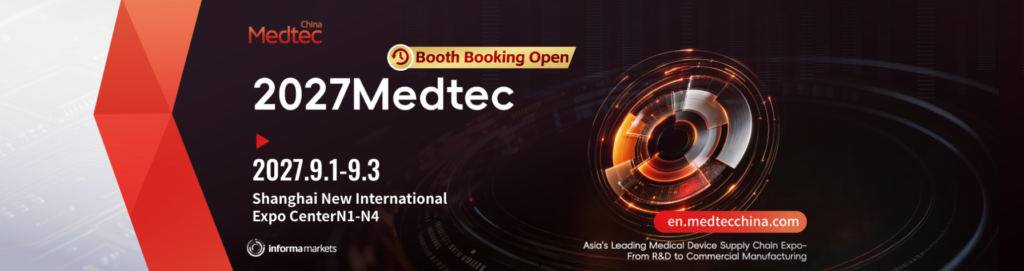
Navigating complex fluid dynamics and structural stability in minimally invasive catheters requires precise material selection alongside advanced processing technologies. Gathering every September across Halls N1 through N4 at the Shanghai New International Expo Center, our annual gathering brings together global research teams, precision component suppliers, and testing specialists under one roof. Working as the Medtec China team, we provide an expansive platform dedicated to medical design innovations, raw material refinement, and quality validation solutions.
Exploring a specialized medical supply expo grants cross-functional delegation teams direct visibility into high-precision polymer extrusion lines, braided hypotubes, and automated burst-pressure testing equipment. Overseas delegates are encouraged to register through our official site today to stay tuned for the 2027 Corporate Delegation Guidelines and organize their upcoming trip to Shanghai.
Advanced Polymer Extrusion Technologies and Multi-Lumen Profiles
Precision extrusion forms the technological backbone of modern vascular access, enabling the production of multi-lumen tubing with intricate cross-sectional geometries. Advanced thermoplastics such as polyether block amide (PEBA), polyurethane, and fluoropolymers undergo tight temperature-controlled melt extrusion to achieve uniform wall thickness. Controlling melt pressure fluctuations prevents inner lumen collapse and maintains strict dimensional tolerances throughout continuous manufacturing runs.
Variable-durometer extrusion techniques permit seamless transitions in shaft flexibility along a single continuous tube. Distal catheter sections demand low-durometer softness to navigate tortuous anatomical pathways without inducing tissue trauma, whereas proximal sections require high-durometer stiffness for optimal pushability. Master extrusion operators optimize screw speed profiles and cooling trough temperatures to manage durometer transition zones accurately.
Co-extrusion platforms allow material engineers to bond chemically distinct polymer layers into a unified composite shaft. Integrating a low-friction fluoropolymer inner liner alongside a bondable outer jacket lowers guidewire insertion forces while maintaining structural integrity. Conducting preliminary rheological analyses prevents delamination issues between adjacent polymer layers during long-term clinical usage.
Micro-Braiding Architectures and Metallic Reinforcement Mechanics
Reinforcing extruded shafts with braided metallic wires enhances torque transmission and kink resistance in complex neurovascular delivery catheters. High-tensile stainless steel or Nitinol wires are woven over removable mandrels using multi-carrier braiding machinery. Adjusting pick count per inch alters shaft flexibility, allowing developers to tailor mechanical behavior along specific catheter segments.
Coiling technologies offer an alternative structural reinforcement mechanism, providing superior radial strength and crush resistance. Combining braided and coiled layers within a single composite shaft allows catheter designers to optimize both pushability and kink performance under sharp bending radii. Fine-tuning wire tension during braiding prevents surface protrusions that could breach outer jacket barriers.
Exhibiting within a comprehensive medical device design and manufacturing trade show, specialized extrusion and braiding equipment manufacturers present active multi-carrier braiding cells, precision puller systems, and inline laser micrometer gauges in real-time operation. Precision jetting valves apply minute droplets of UV-curable adhesive onto braided hypotube transitions with high volumetric accuracy and zero air entrapment. Watching these live automated setups enables production teams to evaluate line speed capabilities and assess cleanroom integration options.
Mechanical Testing Protocols and Quality Validation Systems
Validating catheter performance demands rigorous mechanical testing routines to confirm compliance with international safety standards. Radial compression testing, trackability assessments, and torqueability evaluations simulate anatomical resistance, providing quantitative data on shaft behavior. Automated tensile testing systems measure bond strength across reflowed joint boundaries to prevent catastrophic separation during deployment.
Burst-pressure testing evaluates the ultimate structural integrity of thin-walled catheter tubing under extreme hydraulic loads. Pressurizing fluid pathways at controlled flow rates pinpoints localized material weaknesses and validates seam weld reliability. Integrating automated pressure transducers provides continuous data logging, simplifying regulatory audit trail generation.
Inline visual inspection platforms powered by machine learning algorithms now detect micro-defects during continuous extrusion and braiding runs. High-resolution camera arrays capture multi-angle images of moving tubing shafts, flagging microscopic pinholes, braid gaps, or wall thickness variations within milliseconds. Implementing real-time optical screening safeguards product consistency across continuous multi-shift schedules.
Collaborative Sourcing Strategies and Regulatory Alignment
Navigating global regulatory submission pathways requires complete documentation tracing raw chemical synthesis through final sterile barrier packaging. Original equipment manufacturers must verify that component suppliers hold valid ISO certifications, maintain complete device master files, and follow strict change-control procedures. Clear technical quality agreements established upfront prevent unexpected regulatory delays during international approval filings.
Biocompatibility verification strategies emphasize comprehensive chemical characterization protocols alongside traditional biological screening models. Quantitative extractables and leachables testing evaluates compound migration profiles under aggressive solvent exposure. Conducting early chemical risk assessments simplifies regulatory submission pathways across target global markets.
Risk mitigation planning should balance physical component performance against potential supply chain disruptions. Over-reliance on single-source suppliers exposes manufacturing pipelines to sudden material shortages or international shipping bottlenecks. Cultivating qualified secondary suppliers for critical sub-assemblies maintains operational stability during market shifts.
Conclusion
Optimizing tubing extrusion, mastering braided reinforcement techniques, and verifying mechanical compliance require methodical planning and strong partner engagement. As the team representing Medtec China, we remain focused on creating a collaborative industrial venue where R&D groups, component specialists, and testing experts gather to advance clinical hardware. Gathering each autumn at the Shanghai New International Expo Center, our medical supply expo platform gives delegates direct access to novel materials, cleanroom automation, and specialized technical sessions.
Organize your delegation’s attendance early, connect with premier engineering partners, and refine your technology sourcing strategy; explore our official portal today to review delegation guidelines, check conference details, and plan your Shanghai itinerary.