
Precision components often determine how reliably a medical device can perform, particularly as products become smaller, more intricate, and more demanding in terms of dimensional control. A sourcing strategy built around component technology needs to consider materials, machining, surface treatment, tolerances, inspection, and production scalability as connected questions.
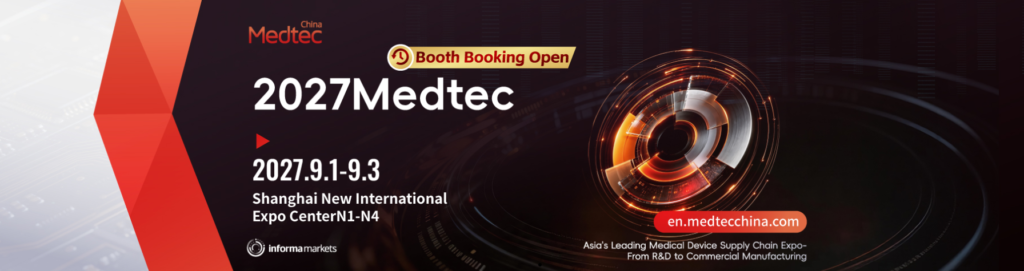
Medtec China Show provides an industry-focused environment for exploring these subjects, while we at Medtec China concentrate on medical device design, R&D, manufacturing, materials, core components, production technologies, and related supply-chain services. Our next edition is scheduled for September 1–3, 2027, at the Shanghai New International Expo Centre in N1–N4. International professionals can review the official event information and plan their technical visit around the component technologies relevant to their projects.
Why Precision Components Matter in Medical Device Development
A component can be small in physical size yet significant in overall device performance. Dimensional variation, surface condition, mechanical strength, thermal behavior, and material compatibility may influence assembly accuracy and long-term reliability. For that reason, component sourcing should begin with the functional requirements of the finished device rather than with a supplier’s available catalog.
Tolerance is another consideration that deserves early attention. Extremely tight specifications can increase machining complexity, inspection requirements, tooling demands, or production costs. On the other hand, specifying tighter tolerances than the application actually requires may add unnecessary manufacturing difficulty. Technical teams should establish which dimensions are function-critical and which allow reasonable process variation.
An international medical expo can provide a useful setting for examining these relationships because visitors can compare manufacturing technologies alongside component resources. Conversations become more productive when teams arrive with drawings, material requirements, expected quantities, and information about the component’s role within the larger assembly.
Examine the Material-Process Relationship
Material selection and manufacturing method cannot always be evaluated separately. Metals, ceramics, polymers, composites, and glass each respond differently to machining, forming, molding, joining, surface treatment, and thermal processing. The final choice may depend on mechanical requirements as well as the geometry and manufacturing route.
Our Medtec China exhibition scope brings materials and precision processing into the same sourcing environment. The N1 and N2 areas cover metallic raw materials and components, advanced ceramic, biological and glass materials, medical-grade polymers and composites, precision laser processing, machine tools, additive manufacturing, molding, tubing and extrusion equipment, and surface treatment technologies. This combination allows visitors to investigate how upstream material decisions interact with production processes.
A Medtec China Show visit can also help teams identify process alternatives before a component design becomes too dependent on one manufacturing route. Comparing conventional machining with additive, molding, extrusion, laser, or surface-treatment options may reveal different approaches to geometry, volume, finishing, and production economics. The most relevant option still needs project-specific technical verification after the initial discussion.
Assess Component Suppliers Beyond Technical Specifications
Supplier evaluation involves more than reviewing dimensional capability. A technically suitable source should also be examined through questions about quality systems, traceability, inspection methods, documentation, production capacity, communication, and development support. These factors become particularly important when a component forms part of a regulated medical device.
Inspection methodology deserves special attention. A supplier may state a particular tolerance, but the sourcing team should understand how that tolerance is measured and controlled. Depending on the component, dimensional inspection, surface analysis, material testing, optical measurement, or other verification methods may be relevant.
During an international medical expo, face-to-face technical discussions can help reveal which questions require additional evidence. Samples, drawings, test reports, quality documents, or process information may still be necessary before a sourcing decision can be made. Exhibition conversations should be treated as the starting point for technical evaluation rather than the final validation step.
Connect Component Sourcing With Production Scale
A component that works well during prototyping may require a different manufacturing strategy at higher production volumes. Tooling investment, cycle time, automation, material availability, inspection frequency, production yield, and process stability can all influence the economics of scaling.
Production volume should consequently be part of the initial supplier discussion. A small development batch may favor flexible processes, while larger quantities can make dedicated tooling or automated production more relevant. The objective is not to assume that one process is universally preferable, but to understand how each option behaves under the project’s expected production conditions.
The broader value of a Medtec China Show lies in the connections between these production questions. A component discussion can naturally extend toward precision manufacturing, automation, testing, quality, and other supply-chain resources. We at Medtec China provide a professional setting where international visitors can examine these related areas and build a more informed view of China’s medical manufacturing ecosystem.
Conclusion
Precision medical components sit at the intersection of material science, manufacturing engineering, dimensional control, quality management, and production planning. Medtec China is a specialized medical device design and manufacturing exhibition that will take place September 1–3, 2027, at the Shanghai New International Expo Centre in N1–N4.
With its focus on the medical device supply chain rather than finished medical products alone, the event brings together resources spanning materials and components, precision manufacturing and processing, manufacturing services and equipment, automation, R&D, testing, packaging, sterilization, and quality-related fields.
Having been held in China for 20 editions, the exhibition has developed alongside the country’s medical device manufacturing sector. We at Medtec China invite international professionals to explore the official 2027 event information and prepare their visit around the component, process, and supplier questions most relevant to their projects.