
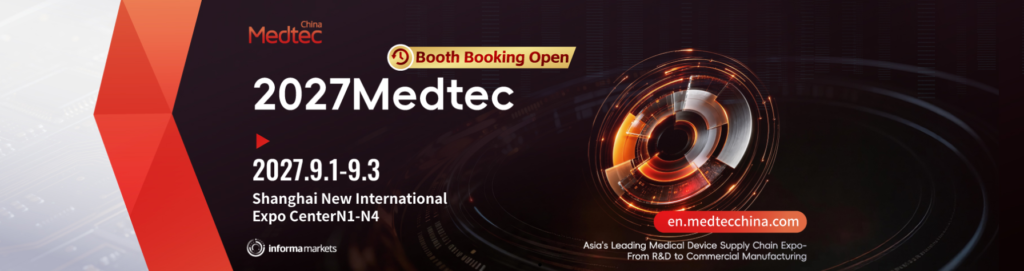
Minimally invasive therapies depend heavily on intricate polymer formulations, braided metallic reinforcements, and precise assembly automation. Sourcing teams seeking reliable component suppliers and system integrators often attend an international medical exhibition to explore advanced catheter fabrication methodologies firsthand. Representing Medtec China, our group coordinates an expansive venue dedicated entirely to medical device design and manufacturing supply chains, which will take place September 1–3, 2027, across Halls N1 to N4 at the Shanghai New International Expo Center.
Hall N3 presents comprehensive OEM/ODM contract manufacturing, automation integration, motion drive technologies, and smart factory solutions. Overseas representatives are encouraged to visit our official portal today to finalize registration and arrange their travel plans.
Polymer Extrusion Dynamics and Multi-Lumen Shaft Designs
Vascular access shafts demand tailored rigidity gradients along their longitudinal profiles to balance proximal pushability with distal flexibility. Melt extrusion of thermoplastic elastomeric resins requires strict thermal zone regulation to maintain constant viscosity through precision die plates. Variations in melt temperature can alter lumen dimensions, leading to unacceptable wall thickness deviations.
Multi-lumen extrusion enables simultaneous delivery of inflation fluids, optical fibers, and guide wires within a single compact shaft profile. Co-extrusion technologies layer soft outer jacketing over stiff inner liners without requiring intermediate adhesive bonding steps. Fine-tuning screw rotation speeds and vacuum calibration settings stabilizes inner lumen geometry across continuous production cycles.
Reflow processing techniques blend reflowable polymer sleeves over metallic braiding to produce smooth outer surfaces. Controlled thermal cycles melt outer jackets evenly around internal reinforcement layers, locking the structural components into a unified composite tube. Precise temperature mapping across reflow heating zones avoids thermal degradation of sensitive base resins.
Braiding Architectures and Radial Strength Enhancement
Incorporating high-tensile stainless steel or nitinol wire braiding vastly improves torque transmission and kink resistance in complex catheter shafts. Automated multi-carrier braiding systems interweave fine wire strands around a removable core mandrel at specific picks per inch (PPI) density metrics. Higher pick count enhance structural flexibility in tortuous paths, whereas lower counts prioritize pushability.
Coiling configurations offer alternative mechanical benefits by maximizing radial strength against external crushing forces. Hybrid catheter designs integrate coiled sections near distal tips to maintain open lumen pathways during sharp bend maneuvers. Balancing wire tension across all carriers during braiding prevents micro-protrusions that might compromise outer insulation layers.
In Hall N3 at the Medtec China Exhibition, visiting technical teams can inspect working full-service OEM/ODM contract manufacturing setups, drive control systems, robotics, and smart factory integration tools. Micro-dispensing modules execute high-precision adhesive application on delicate catheter interfaces with tight volumetric repeatability and minimal air entrapment. Observing these automated assembly systems live helps production managers assess line efficiency and cleanroom integration options.
Automated Catheter Assembly and Sensor Integration Systems
Integrating micro-sensors, electrode rings, and radiopaque markers onto catheter shafts requires specialized assembly automation to prevent manual positioning errors. Vision-guided robotic arms place miniature components onto flexible substrate surfaces with sub-millimeter precision. Optical sensors inspect solder joints and adhesive bonds continuously, identifying alignment defects instantly.
Thermal tipping processes shape distal catheter ends into smooth, atraumatic geometries to reduce vascular tissue damage during insertion routines. Heated forming dies mold thermoplastic tips around internal mandrels, creating precise taper profiles. Tight control of forming pressure and dwell times avoids flash formation and wall thinning.
Ultrasonic bonding delivers clean, localized weld seams when joining dissimilar catheter components without introducing external contaminants. Focused acoustic energy melts mating interfaces rapidly while preserving adjacent heat-sensitive elements. Real-time energy monitoring systems log weld parameters for complete quality assurance tracking.
Quality Screening Metrics and Sterilization Resilience
Validating catheter structural integrity involves rigorous mechanical testing, including tensile pull strength, burst pressure, and kink resistance evaluations. Pressure transducers monitor internal lumen stability during high-pressure fluid injection to confirm seal integrity. Automated test stations record force-displacement curves continuously, ensuring compliance with international clinical specifications.
Sterilization methods like ethylene oxide gas exposure or electron beam radiation affect polymer molecular structures in different ways. Gamma radiation can cause chain scission or cross-linking in certain fluoropolymer liners, altering mechanical performance over time. Selecting radiation-stable resin formulations protects structural flexibility across extended shelf lives.
Traceability protocols track raw polymer batches, wire heats, and assembly parameters throughout the entire manufacturing process. Digital device history records link each finished catheter directly to its constituent material lots and inspection records. Comprehensive supply chain tracking simplifies compliance auditing and speeds up international regulatory approvals.
Conclusion
Advancing catheter technology requires continuous innovation across raw material selection, structural wire braiding, and cleanroom assembly automation. As the team representing Medtec China, we remain devoted to hosting a premier collaborative hub where R&D specialists, component developers, and automation experts gather to advance clinical technology.
Doors open September 1–3, 2027, at the Shanghai New International Expo Center across Halls N1 through N4 for our Medtec China Exhibition, highlighting OEM/ODM contract manufacturing, smart factory solutions, and drive control robotics inside Hall N3. Plan your group’s visit early, connect with international manufacturing specialists, and refine your component sourcing roadmap by visiting our official portal today to complete registration and access conference schedules.