
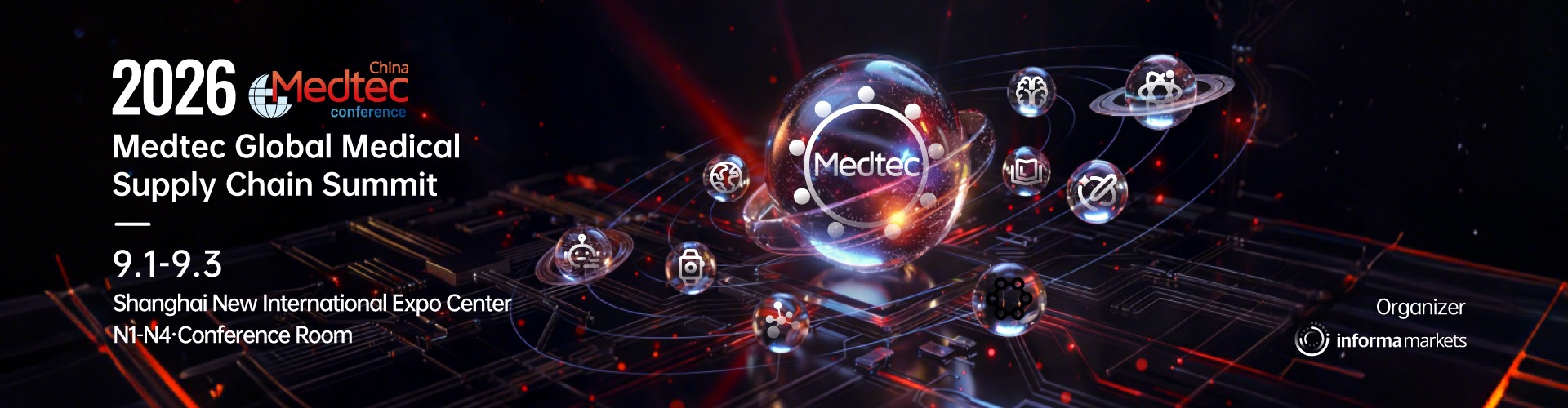
Supply chain pressure in IVD has changed. Buyers are no longer looking only for competitive pricing or basic capacity. They need suppliers that can support quality, speed, precision, and resilience at the same time. The Medtec China supply chain expo is positioned as a medical device design and manufacturing expo, bringing together component makers, material suppliers, automation providers, contract manufacturers, and technical service partners across the medical device value chain. The event takes place September 1 to 3, 2026 at Shanghai New International Expo Centre in Pudong. Visitor badge applications open from April 1, 2026, and early registration completed before August 30th is free. If your team wants a clearer view of where diagnostics sourcing is heading, now is the right time to map your priorities, shortlist the right supplier categories, and register for Medtec China.
In this post, you’ll learn:
- which IVD supply chain trends are likely to shape conversations in 2026
- why those trends matter for sourcing, engineering, and operations
- what to ask suppliers on the show floor
- how to spot real fit instead of surface-level claims
Why IVD supply chain trends matter more in 2026
IVD companies are working in a tighter operating environment. Product performance expectations remain high, but teams also face pressure to reduce delays, control cost, and qualify suppliers faster.
That changes what matters at an event like medical expo China 2026. Attendees are not just browsing for new contacts. They are looking for suppliers that can help solve practical problems, such as:
- unstable component availability
- inconsistent material quality
- slow qualification cycles
- rising automation needs
- stricter quality and documentation expectations
The most useful trend conversations will focus on what improves execution, not just what sounds innovative.
Precision components will stay under the spotlight
IVD systems rely on tight tolerances and repeatable performance. Even small variation in fluid handling parts, molded components, seals, connectors, or mechanical subassemblies can affect product reliability.
Why precision matters in IVD
Diagnostics products often depend on controlled movement, stable interfaces, and predictable part behavior. That is true for both instrument-based systems and disposable test components.
In 2026, buyers will likely pay closer attention to suppliers that can show:
- repeatable dimensional control
- stable process capability
- experience with small or complex parts
- support for scale-up without quality drift
What to ask suppliers
A good booth conversation should move quickly past broad capability claims. Ask:
- What tolerances can you hold consistently?
- What inspection methods support repeatability?
- Can you support both prototyping and production?
- What similar IVD or medical applications have you handled?
Practical takeaway: If a supplier cannot explain how they control variation, they may not be ready for serious follow-up.
Materials selection is becoming a bigger sourcing issue
Materials have always mattered in diagnostics, but they now carry more weight across design, cost, compliance, and supply continuity.
What buyers are likely to watch
Expect strong interest in materials that support:
- chemical compatibility
- stable performance in fluid-contact applications
- clean processing
- lot-to-lot consistency
- easier traceability
For IVD manufacturers, the right material is not just a product decision. It is also a supply chain decision. A technically strong material with weak supply continuity can become a real business risk.
What to ask material suppliers
Use direct questions that test both performance and sourcing strength:
- How stable is your upstream supply?
- What documentation supports traceability?
- How do you manage formulation or source changes?
- What medical or IVD applications is this material already used in?
Common mistake to avoid: Do not focus only on material performance data. Ask how the supplier manages consistency over time.
Automation will matter for both cost and control
Automation is no longer just a growth investment. For many IVD manufacturers, it is becoming a practical way to improve output consistency, reduce manual variation, and support faster scaling.
Where automation is likely to get attention
At the event, expect interest in automation tied to:
- assembly efficiency
- in-line inspection
- vision-based quality checks
- fluid handling consistency
- digital process monitoring
These areas matter because diagnostics production often includes repetitive, quality-sensitive steps where small errors create downstream problems.
What buyers should look for
When reviewing automation providers or manufacturing partners, watch for solutions that improve a real process, not just a demo.
Useful questions include:
- What manufacturing problem does this system solve best?
- What kind of output or quality improvement is realistic?
- How difficult is implementation?
- Can the system support validation and traceability needs?
Decision rule: If the automation does not clearly support quality, throughput, or labor efficiency, it may be more buzzword than business value.
Quality expectations are rising across supplier evaluation
In IVD, supplier quality is not a side topic. It directly affects qualification speed, audit confidence, and long-term reliability.
What is changing in supplier conversations
Buyers are asking more detailed questions about:
- process controls
- change management
- traceability
- nonconformance handling
- documentation readiness
This means suppliers need to show more than a polished booth presence. They need to communicate how quality works in practice.
What attendees should ask
Whether you are meeting a component supplier, material provider, or contract manufacturer, ask:
- How do you handle change control?
- What records can you provide during qualification?
- How do you manage traceability?
- What happens when nonconformance appears?
- How quickly can you support documentation requests?
Practical takeaway: Strong suppliers usually answer quality questions clearly and specifically. Weak suppliers often stay general.
Supplier resilience is now a major buying factor
A supplier that performs well in normal conditions but struggles under pressure can create serious downstream risk. That is why resilience will remain a key sourcing trend in 2026.
What resilience means in practice
For IVD teams, supplier resilience usually includes:
- stable raw material access
- backup planning
- production continuity
- realistic lead time management
- clear communication when conditions change
This matters even more for diagnostics products tied to time-sensitive demand or regulated production environments.
Questions to ask about resilience
Try asking:
- How do you manage supply disruption risk?
- Do you have alternate raw material or process plans?
- What lead time pressures affect your category most?
- How do you communicate delays or changes to customers?
A supplier does not need a perfect answer to every risk question. But they should show that they think about continuity in a structured way.
Speed to qualification is becoming a competitive advantage
In many IVD programs, the slowest part of supplier change is not finding options. It is qualifying them.
Why this trend matters
Companies want to shorten the gap between initial supplier contact and practical onboarding. That makes responsiveness, documentation, and technical clarity more important than ever.
Suppliers that can support faster qualification often stand out because they can provide:
- relevant technical information quickly
- clear documentation packages
- faster sample coordination
- better support for audits or follow-up reviews
What to watch for at the event
Look for suppliers that make the next step easy. That may mean they can quickly explain:
- what they do best
- what applications they support
- what documents they can share
- how they handle sample or RFQ requests
- what the qualification path looks like
Practical takeaway: A supplier that is easy to evaluate is often easier to onboard.
How to use Medtec China 2026 more effectively for IVD sourcing
A busy show can create too many conversations and too little clarity. The best approach is to go in with a short list of priorities.
Before the show
Focus your team on:
- top product or sourcing risks
- supplier categories tied to active programs
- must-ask questions by function
- clear definitions of what makes a supplier worth follow-up
During the show
Stay disciplined by:
- starting with high-priority categories
- comparing similar suppliers on the same day
- recording strengths, risks, and next steps right after meetings
- revisiting strong-fit suppliers for deeper discussion
After the show
Move quickly to:
- rank suppliers by fit and urgency
- assign follow-up owners
- request documentation or samples
- drop low-value leads early
Conclusion
IVD supply chain trends in 2026 will center on what helps teams operate with more control: precision components, dependable materials, useful automation, stronger quality systems, supplier resilience, and faster qualification. At Medtec China 2026, the most valuable conversations will be the ones that connect these trends to real sourcing needs. Go in with clear questions, focus on suppliers that can explain how they work, and use the event to build a stronger shortlist for the months ahead. Which of these trends is most urgent for your IVD team right now?Supply chain pressure in IVD has changed. Buyers are no longer looking only for competitive pricing or basic capacity. They need suppliers that can support quality, speed, precision, and resilience at the same time. The Medtec China supply chain expo is positioned as a medical device design and manufacturing expo, bringing together component makers, material suppliers, automation providers, contract manufacturers, and technical service partners across the medical device value chain. The event takes place September 1 to 3, 2026 at Shanghai New International Expo Centre in Pudong. Visitor badge applications open from April 1, 2026, and early registration completed before August 30th is free. If your team wants a clearer view of where diagnostics sourcing is heading, now is the right time to map your priorities, shortlist the right supplier categories, and register for Medtec China.
In this post, you’ll learn:
- which IVD supply chain trends are likely to shape conversations in 2026
- why those trends matter for sourcing, engineering, and operations
- what to ask suppliers on the show floor
- how to spot real fit instead of surface-level claims
Why IVD supply chain trends matter more in 2026
IVD companies are working in a tighter operating environment. Product performance expectations remain high, but teams also face pressure to reduce delays, control cost, and qualify suppliers faster.
That changes what matters at an event like medical expo China 2026. Attendees are not just browsing for new contacts. They are looking for suppliers that can help solve practical problems, such as:
- unstable component availability
- inconsistent material quality
- slow qualification cycles
- rising automation needs
- stricter quality and documentation expectations
The most useful trend conversations will focus on what improves execution, not just what sounds innovative.
Precision components will stay under the spotlight
IVD systems rely on tight tolerances and repeatable performance. Even small variation in fluid handling parts, molded components, seals, connectors, or mechanical subassemblies can affect product reliability.
Why precision matters in IVD
Diagnostics products often depend on controlled movement, stable interfaces, and predictable part behavior. That is true for both instrument-based systems and disposable test components.
In 2026, buyers will likely pay closer attention to suppliers that can show:
- repeatable dimensional control
- stable process capability
- experience with small or complex parts
- support for scale-up without quality drift
What to ask suppliers
A good booth conversation should move quickly past broad capability claims. Ask:
- What tolerances can you hold consistently?
- What inspection methods support repeatability?
- Can you support both prototyping and production?
- What similar IVD or medical applications have you handled?
Practical takeaway: If a supplier cannot explain how they control variation, they may not be ready for serious follow-up.
Materials selection is becoming a bigger sourcing issue
Materials have always mattered in diagnostics, but they now carry more weight across design, cost, compliance, and supply continuity.
What buyers are likely to watch
Expect strong interest in materials that support:
- chemical compatibility
- stable performance in fluid-contact applications
- clean processing
- lot-to-lot consistency
- easier traceability
For IVD manufacturers, the right material is not just a product decision. It is also a supply chain decision. A technically strong material with weak supply continuity can become a real business risk.
What to ask material suppliers
Use direct questions that test both performance and sourcing strength:
- How stable is your upstream supply?
- What documentation supports traceability?
- How do you manage formulation or source changes?
- What medical or IVD applications is this material already used in?
Common mistake to avoid: Do not focus only on material performance data. Ask how the supplier manages consistency over time.
Automation will matter for both cost and control
Automation is no longer just a growth investment. For many IVD manufacturers, it is becoming a practical way to improve output consistency, reduce manual variation, and support faster scaling.
Where automation is likely to get attention
At the event, expect interest in automation tied to:
- assembly efficiency
- in-line inspection
- vision-based quality checks
- fluid handling consistency
- digital process monitoring
These areas matter because diagnostics production often includes repetitive, quality-sensitive steps where small errors create downstream problems.
What buyers should look for
When reviewing automation providers or manufacturing partners, watch for solutions that improve a real process, not just a demo.
Useful questions include:
- What manufacturing problem does this system solve best?
- What kind of output or quality improvement is realistic?
- How difficult is implementation?
- Can the system support validation and traceability needs?
Decision rule: If the automation does not clearly support quality, throughput, or labor efficiency, it may be more buzzword than business value.
Quality expectations are rising across supplier evaluation
In IVD, supplier quality is not a side topic. It directly affects qualification speed, audit confidence, and long-term reliability.
What is changing in supplier conversations
Buyers are asking more detailed questions about:
- process controls
- change management
- traceability
- nonconformance handling
- documentation readiness
This means suppliers need to show more than a polished booth presence. They need to communicate how quality works in practice.
What attendees should ask
Whether you are meeting a component supplier, material provider, or contract manufacturer, ask:
- How do you handle change control?
- What records can you provide during qualification?
- How do you manage traceability?
- What happens when nonconformance appears?
- How quickly can you support documentation requests?
Practical takeaway: Strong suppliers usually answer quality questions clearly and specifically. Weak suppliers often stay general.
Supplier resilience is now a major buying factor
A supplier that performs well in normal conditions but struggles under pressure can create serious downstream risk. That is why resilience will remain a key sourcing trend in 2026.
What resilience means in practice
For IVD teams, supplier resilience usually includes:
- stable raw material access
- backup planning
- production continuity
- realistic lead time management
- clear communication when conditions change
This matters even more for diagnostics products tied to time-sensitive demand or regulated production environments.
Questions to ask about resilience
Try asking:
- How do you manage supply disruption risk?
- Do you have alternate raw material or process plans?
- What lead time pressures affect your category most?
- How do you communicate delays or changes to customers?
A supplier does not need a perfect answer to every risk question. But they should show that they think about continuity in a structured way.
Speed to qualification is becoming a competitive advantage
In many IVD programs, the slowest part of supplier change is not finding options. It is qualifying them.
Why this trend matters
Companies want to shorten the gap between initial supplier contact and practical onboarding. That makes responsiveness, documentation, and technical clarity more important than ever.
Suppliers that can support faster qualification often stand out because they can provide:
- relevant technical information quickly
- clear documentation packages
- faster sample coordination
- better support for audits or follow-up reviews
What to watch for at the event
Look for suppliers that make the next step easy. That may mean they can quickly explain:
- what they do best
- what applications they support
- what documents they can share
- how they handle sample or RFQ requests
- what the qualification path looks like
Practical takeaway: A supplier that is easy to evaluate is often easier to onboard.
How to use Medtec China 2026 more effectively for IVD sourcing
A busy show can create too many conversations and too little clarity. The best approach is to go in with a short list of priorities.
Before the show
Focus your team on:
- top product or sourcing risks
- supplier categories tied to active programs
- must-ask questions by function
- clear definitions of what makes a supplier worth follow-up
During the show
Stay disciplined by:
- starting with high-priority categories
- comparing similar suppliers on the same day
- recording strengths, risks, and next steps right after meetings
- revisiting strong-fit suppliers for deeper discussion
After the show
Move quickly to:
- rank suppliers by fit and urgency
- assign follow-up owners
- request documentation or samples
- drop low-value leads early
Conclusion
IVD supply chain trends in 2026 will center on what helps teams operate with more control: precision components, dependable materials, useful automation, stronger quality systems, supplier resilience, and faster qualification. At Medtec China 2026, the most valuable conversations will be the ones that connect these trends to real sourcing needs. Go in with clear questions, focus on suppliers that can explain how they work, and use the event to build a stronger shortlist for the months ahead. Which of these trends is most urgent for your IVD team right now?